By Chris Bowen | Founder & CEO, Bowen & Company
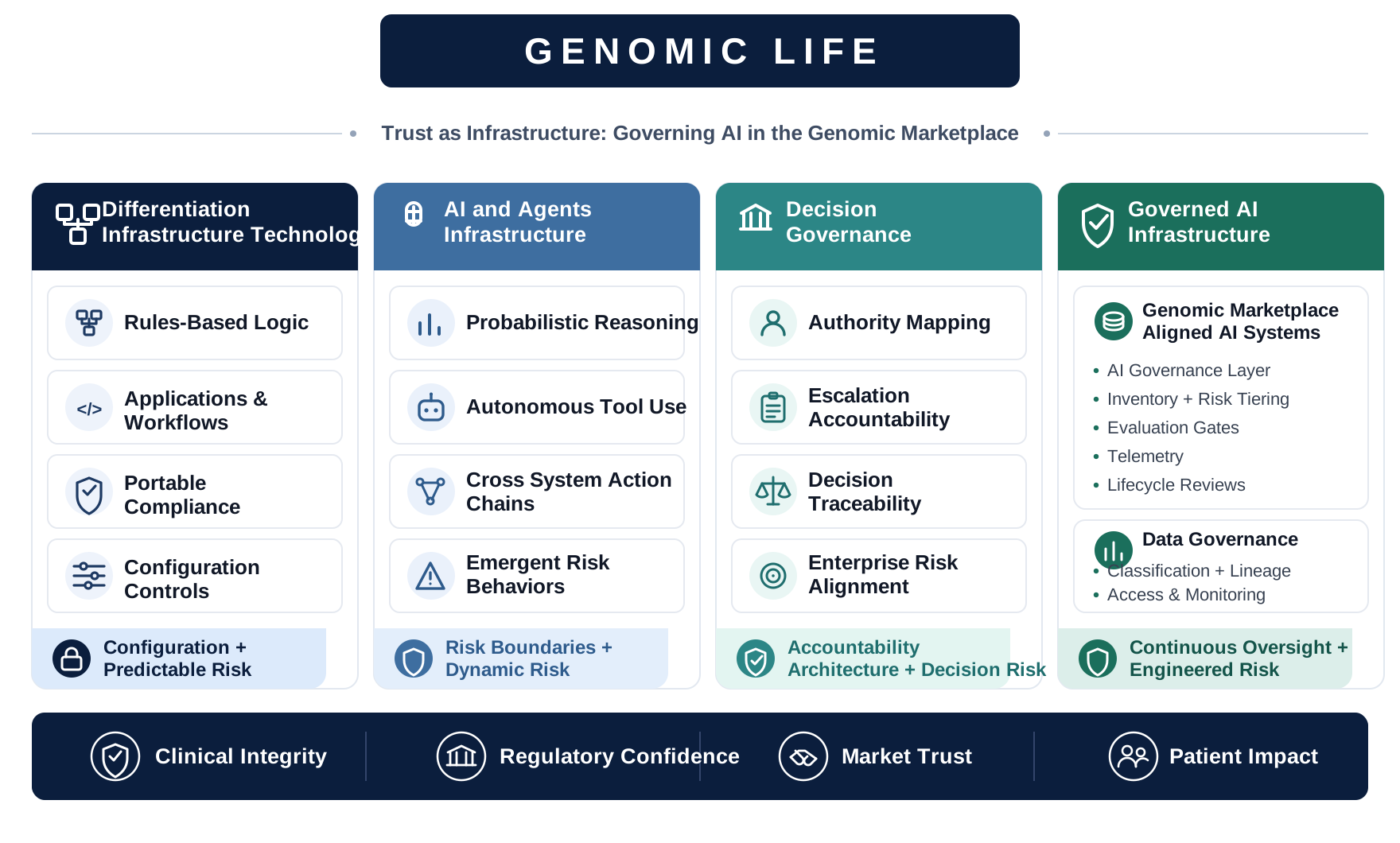
Healthcare is entering a structural inflection point, and the numbers show why. The genomics market is on pace to roughly double by 2030, from an estimated $58 billion in 2026 to over $107 billion — a 16.5% compound annual growth rate that will pull genetic data deeper into mainstream care navigation, employer benefits design, and clinical decision-making. At the same time, healthcare remains the most expensive industry in the world for a data breach, at $7.42 million on average — the fifteenth consecutive year it has held that unwanted distinction. Layer agentic AI onto that combination — high-growth, high-sensitivity data, in an industry that already leads every sector in breach cost — and the margin for error narrows considerably.
Traditional healthcare IT was built on deterministic systems: rules engines, EHR workflows, static integrations, and periodic compliance testing. These systems were designed to behave predictably, and audits were designed to confirm that predictability. Agentic AI breaks that assumption. It introduces probabilistic reasoning, autonomous tool use, adaptive decision chains, and behavior that evolves after deployment rather than freezing at go-live.
This shift fundamentally changes enterprise risk management.
AI does not arrive into a neutral environment. It arrives into the enterprise architecture that already exists — legacy integrations, inconsistent data models, undocumented pipelines, and governance gaps that human judgment has quietly compensated for over time. AI removes that compensation. It interrogates data at a speed and depth no human analyst could, without the institutional knowledge to navigate inconsistencies the way an experienced analyst would. The consequence: AI does not simply depend on sound data governance and enterprise architecture — it amplifies whatever is already there, good or bad. A useful comparison is the 2003 Northeast blackout: a single Ohio transmission line sagged into a tree, and a software bug in the utility's alarm system left operators blind to the need to rebalance load. Ninety minutes later, cascading overloads had cut power to 50 million people across eight states and Ontario. Neither the tree contact nor the software bug was, alone, the root cause — the absence of a monitoring and governance layer capable of containing the fault was. Gaps that are invisible or manageable at human scale become clinical risk, compliance exposure, and trust liability at AI scale. Organizations that defer foundational data and architecture remediation while adopting AI will find that AI accelerates the consequences of that debt, not the resolution of it.
Risk no longer arises solely from configuration or access failures. It now emerges from dynamic system behavior, cross-system action chains, and AI-influenced decisions that intersect with navigation, member engagement, and regulated data environments. Governance must extend beyond data quality and model validation to address this directly.
Mature AI environments require three integrated control planes:
- Data Governance — governs inputs
- AI Governance — governs outputs and system behavior
- Decision Governance — governs authority and accountability
Decision Governance ensures that when AI systems influence or initiate actions, authority, escalation pathways, human oversight, and accountability are clearly defined within enterprise risk structures. It is the control plane most absent in organizations today — and the one most likely to determine whether an AI-related incident becomes a contained event or a front-page one.
This is not a technology upgrade. It is a governance, risk, and compliance evolution. The roadmap that follows sequences that evolution deliberately: closing foundational gaps before they are amplified, and building AI as a governed strategic capability rather than an unmanaged feature.
The Paradigm Shift
1 — From Deterministic Control to Bounded Autonomy
Old model: systems behave predictably. Controls verify configuration and access. Audit proves settings were correct.
AI / agentic model: outputs are probabilistic. Systems plan, reason, and call tools. Risk emerges from chains of actions, not single transactions. Audit must prove bounded autonomy, not perfect output.
The closest working analogy isn't IT — it's fly-by-wire aviation. A modern airliner's flight control computer doesn't execute a pilot's stick input directly; it interprets intent and translates it into control-surface movement, constantly filtered through flight envelope protection. The aircraft is allowed to reason and adapt within the envelope, but it is physically prevented from exceeding stall angle or structural load limits, regardless of what the pilot commands. That's bounded autonomy: real freedom of action, inside limits the system cannot cross no matter how it reasons.
Agentic AI in a genetics-based navigation program needs the same design principle. In an environment where personalized guidance intersects with ePHI and multi-stakeholder trust, this shift is existential. Trust is the enabling infrastructure behind a Genomic Marketplace — a two-sided network of labs, payers, employers, and members. If trust erodes, adoption slows, clients hesitate, and the network effects that make the marketplace valuable never materialize. Roughly half of adults (51%) already report making an important health decision based on AI output without consulting a medical professional, while public trust in healthcare AI has actually been declining — openness dropped from 52% to 42% year over year, and average consumer trust sits at 6.6 out of 10. People are using the technology faster than they're coming to trust it. That gap is the whole ballgame.
As a result, the compliance question changes. We are no longer proving the system always behaves correctly. We are proving it operates safely within defined boundaries, under continuous oversight — the flight envelope, not the flight plan.
2 — From Static Risk Controls to Continuous Risk Engineering
AI systems introduce failure modes that didn't exist in deterministic software: model drift, prompt injection, tool misuse, data leakage, emergent decision pathways, automation creep. None of these show up in a point-in-time control test. Compliance becomes less about periodic control testing and more about continuous monitoring: output sampling, telemetry, drift detection, AI-specific incident classification, and third-party AI provenance and vendor governance validation.
This resembles pharmacovigilance more than traditional IT control testing. A drug's FDA approval is a snapshot; the real safety work happens afterward, through adverse event reporting and periodic safety update reports that catch problems only visible at population scale, over time, in the real world. AI governance needs the same post-deployment discipline — the model that passed validation in a controlled test set can still develop a drift or a bias no pre-launch review could have caught.
That discipline has to extend past your own walls. Organizations must account for AI introduced through partner and vendor ecosystems — and most aren't. 98% of organizations already have unsanctioned applications in use, shadow AI chief among them, yet only 18% have a formal AI security policy in place. When shadow AI is present at scale, it adds an average of $670,000 to breach cost — a 16% premium over organizations with little or none. Ungoverned AI upstream of your workflows creates risk your internal controls cannot fully contain, no matter how mature your own program is.
3 — From Application Governance to an AI Governance Layer
For digital health companies, foundational architecture already includes cloud infrastructure and microservices, EHR/CRM/ERP platforms, data pipelines and integration services, enterprise data and reporting platforms, laboratory and clinical system integrations, evidence-based clinical guideline repositories, and member and communication workflows.
AI now sits across all of it. AI is a capability layer; decision authority is a governance layer. The two are not the same thing, and treating them as interchangeable is where most programs go wrong.
Companies need a formal AI governance layer that includes AI policies and controls, an AI inventory, guideline versioning logic (NCCN, ACMG), risk tiering by autonomy and data sensitivity, defined escalation gates, telemetry standards, lifecycle reassessment, AI cost controls (token/TCO management), and AI-specific incident response.
4 — Introducing the Third Control Plane: Decision Governance
As AI systems evolve from assistive tools to navigation-influencing and operational capabilities, governance must extend beyond data integrity and model performance.
Decision Governance defines who holds authority when AI systems influence or initiate actions. It establishes authority mapping aligned to autonomy tiers, defined escalation thresholds and oversight triggers, clear human-in-the-loop expectations by risk category, end-to-end decision traceability standards, and explicit alignment of AI-influenced decisions with enterprise risk ownership and liability structures.
This third control plane ensures AI does not operate in a vacuum of accountability. It integrates intelligent systems into existing governance, compliance, and executive oversight frameworks — so that when something goes wrong, there is never a question of who owned the decision.
The Three Control Planes of Governed AI
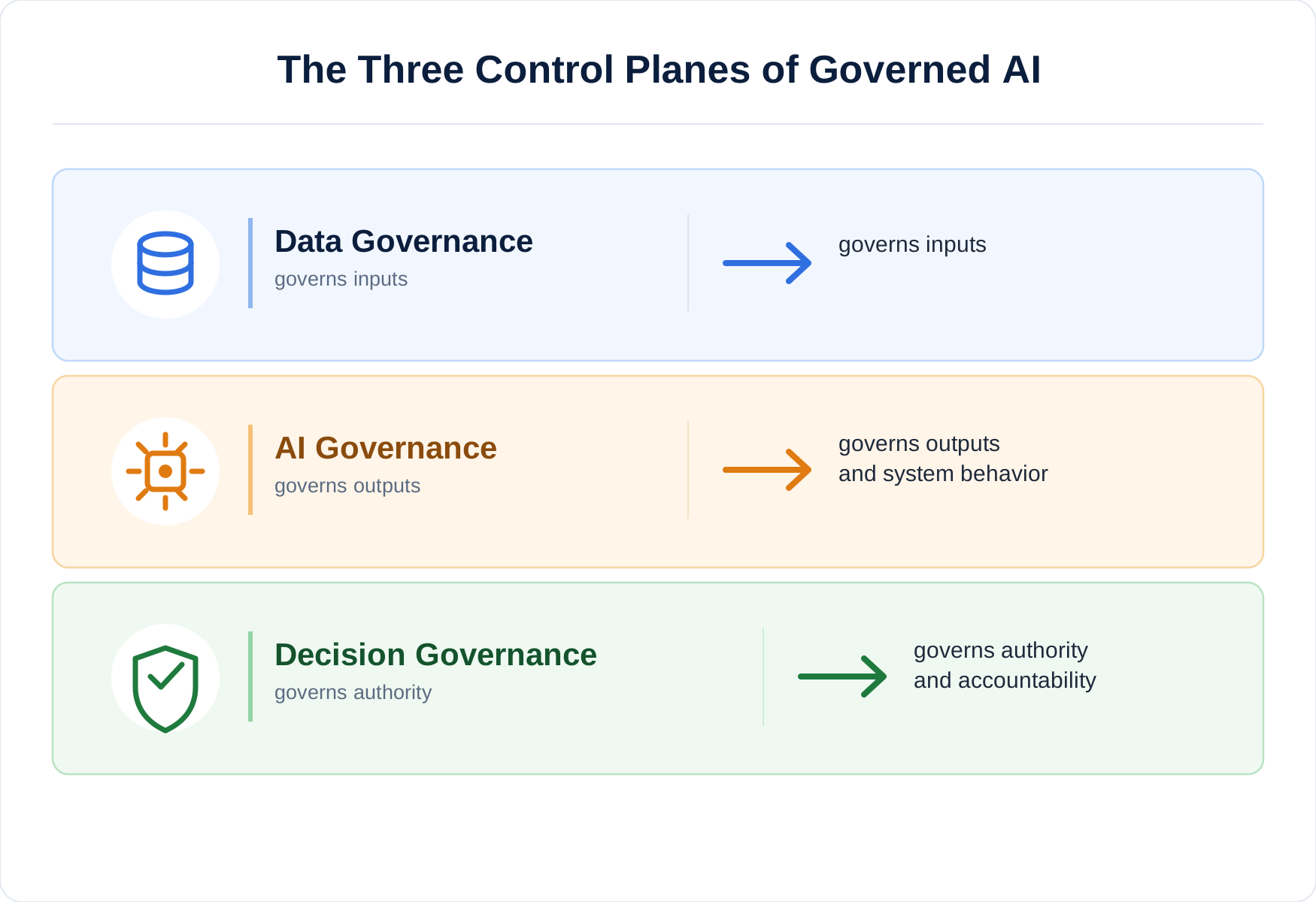
These three planes operate together. Data Governance without AI Governance leaves you validating clean inputs feeding an unmonitored model. AI Governance without Decision Governance leaves you with a well-monitored model no one is accountable for when it acts. All three, integrated, are what "governed AI" actually means — not a slide, a working system.
Why This Matters in Genetics-Based Healthcare Navigation
Organizations in this space operate at the intersection of PHI/PII, clinical interpretation and evidence-based decision support, clinical navigation, employer-sponsored healthcare programs, evidence-based guidelines, regulatory and state scrutiny, member trust, and barriers to access. Few sectors stack that much sensitivity and that much growth in the same place.
Agentic AI will be used to document and annotate clinical notes and calls (ambient clinical intelligence), summarize clinical guidelines, assist navigators, detect anomalies, personalize member outreach, recommend next steps in care pathways, automate compliance processes, and create new features and applications. Clinicians see both sides of that clearly: in Wolters Kluwer's 2026 Future Ready Healthcare survey, 74% cite hallucination risk, 74% cite deskilling risk, and 72% cite advertiser-driven bias as top concerns with clinical AI — while 70% still expect it to improve patient health literacy and engagement. Those aren't contradictory findings. They're the same workforce asking for the guardrails before it fully commits.
The difference between assistive AI and decision-making AI must be explicitly governed. Trust in this sector is cumulative and fragile — it's built member interaction by member interaction and can be lost in one bad one. AI governance must enhance trust, not erode it.
The Strategic Objective
The goal is not to slow innovation. We choose guardrails over handcuffs — flight envelope protection, not a locked cockpit.
The goal is to build a scalable AI governance model that enables safe autonomy without creating bureaucratic paralysis. The right approach is phased, risk-tiered, and aligned with enterprise goals and objectives.
Integrated AI & Data Governance Roadmap
For Genetics-Based Healthcare Navigation
Phase 1 — Establish Controlled Foundations (0–3 Months)
Objective: Prevent unmanaged AI sprawl and establish clear boundaries for data use and system autonomy. This phase is about control, visibility, and containment — not bureaucracy.
1. Unified AI + Data Inventory. Finalize an AI policy. Catalog AI systems, agents, models, and workflows, and map each to its data sources, PHI/PII exposure level, system owner, and autonomy tier. Identify authoritative navigation and clinical sources. Define a decision authority matrix aligned to autonomy tiers, and document which AI outputs are advisory, operational, or decision-influencing. This creates one shared source of truth — the inventory most organizations discover they don't actually have once they go looking.
2. Risk Tiering Based on Autonomy + Data Sensitivity. Define tiers using both autonomy level (informational → operational → navigation-influencing) and data sensitivity (no PHI → limited PHI → navigation and clinical context). This prevents over-controlling low-risk use cases while elevating oversight where it's actually needed.
3. Data Boundaries as Autonomy Controls. Before focusing on models, define approved datasets for AI use, explicit PHI handling constraints, prohibited data uses (training, retention, memory), least-privilege data access for agents, and tool allowlists. Key principle: autonomy is bounded by data access, not by policy language alone.
4. Minimum Telemetry Standard. Every AI workflow logs model/version, prompt template ID, data classification of inputs, tools invoked, output, and reviewer if required. This creates auditability from day one — and it's the same instrumentation that, at scale, lets AI-augmented security operations detect and contain breaches roughly 80 days faster and $1.9 million cheaper. Telemetry isn't overhead; it's the fastest payback item on this whole roadmap.
Phase 1 outcome: You eliminate shadow AI, define data guardrails, and establish bounded autonomy without building a heavy program.
Phase 2 — Operationalize Trust and Observability (3–9 Months)
Objective: Move from policy and guardrails to measurable oversight and resilience. This phase is about visibility and continuous evaluation.
1. AI + Data Lineage Integration. Map model inputs to specific datasets, track changes to data schemas, trace outputs back to authoritative sources, and monitor guideline updates before integration. Implement decision traceability logging standards and an escalation accountability workflow, and align AI-triggered actions with defined human oversight thresholds. This is where data governance becomes dynamic instead of a point-in-time exercise.
2. Agent Threat Modeling. Using frameworks like MITRE ATLAS and the OWASP Top 10 for LLM Applications, evaluate prompt injection risk, data exfiltration risk, tool misuse, runaway autonomy, and cross-system escalation paths. Treat this the way you'd treat any adversarial threat model — because agentic systems, unlike static software, have to be modeled as something an adversary can talk to.
3. Evaluation and Drift Monitoring. Implement an output sampling strategy, hallucination or deviation tracking, data drift detection, and model performance variance alerts. Treat AI outputs the way you'd treat safety monitoring in a clinical setting — continuous, not periodic.
4. AI-Specific Incident Response. Define events such as PHI exposure, clinical misrepresentation, tool misuse, and model drift beyond threshold. Integrate into existing incident response rather than standing up a separate, parallel process — a second incident response track is a governance gap of its own.
Phase 2 outcome: You can demonstrate to leadership, auditors, and clients that AI systems are observable, bounded, and continuously monitored.
Phase 3 — Institutionalize AI as a Governed Strategic Capability (9–18 Months)
Objective: Scale AI safely as a core enterprise capability and competitive differentiator.
1. Lifecycle Governance. For each AI system: pre-deployment review aligned to risk tier, defined acceptable risk criteria, periodic reassessment cadence, formal retirement and decommission criteria, and a formal Decision Governance review built into lifecycle controls. Add dashboard reporting of AI-influenced decisions by risk tier, and explicit mapping of decision accountability to enterprise risk ownership. Data sources feeding AI require lifecycle review as well — a model is only as governed as the data pipeline underneath it.
2. Integrated Risk Dashboard. Leadership visibility into AI systems by autonomy tier, data exposure categories, drift metrics and performance deviations, active incidents and remediation timelines, and risk posture against defined appetite. Trust becomes measurable and reportable, not a talking point.
3. Formal Alignment to External Frameworks. Map internal governance to HITRUST r2 controls, the NIST AI Risk Management Framework (structured around Govern, Map, Measure, and Manage), and HITRUST's AI-specific control set — now up to 44 controls purpose-built for AI systems. Do this once operational maturity exists. Do not lead with mapping; lead with capability. Framework alignment should document a program you already run, not substitute for one you don't.
4. Cultural and Training Integration. Role-based enablement: compliance teams on AI risk evaluation and appetite alignment, technology teams on secure agent architecture and bounded autonomy, clinical/navigation teams on oversight expectations, and security teams on AI threat modeling and monitoring. This phase embeds AI thinking into the organization's operating model rather than leaving it siloed in one team.
Phase 3 outcome: Decision authority, accountability, and oversight are fully embedded into enterprise governance structures.
Guiding Principles to Avoid "Boiling the Ocean"
- Govern by risk, autonomy level, and data sensitivity.
- Start with inventory and telemetry before expanding policy.
- Do not apply clinical-level governance to low-risk use cases.
- Align AI governance with existing enterprise risk management — don't build a parallel structure.
- Build education in parallel. This is a cultural shift in enterprise thinking, not a control checklist.
The Competitive Opportunity
The genomics market's trajectory toward $107 billion by 2030 means the organizations that get governance right now will be scaling into that growth with a trust advantage, not scrambling to retrofit one later. Companies in personalized health and navigation that implement disciplined AI governance early will increase navigator impact, improve personalization, reduce operational friction, strengthen trust with employers and employees, and be prepared for the regulatory expansion that inevitably follows a fast-growing, high-sensitivity market.
In this sector, trust is not just compliance. It is market differentiation — arguably the only kind that compounds.
Closing Perspective
Every major technology shift — virtualization, cloud, mobile, cybersecurity — created winners and laggards. The winners embraced the shift early, integrated governance into innovation rather than bolting it on afterward, treated risk as a technology discipline rather than a legal one, and educated leadership and staff in parallel with deployment.
AI and agentic systems are foundational to the future of genetics-based healthcare navigation. The question is not whether to adopt them. The question is whether we will build the governance maturity to use them as a force multiplier — without compromising clinical integrity, privacy, or trust.
Sources
- IBM, "Cost of a Data Breach: The Healthcare Industry" — healthcare breach cost, 15-year ranking
- IBM, "2025 Cost of a Data Breach: Navigating the AI Rush Without Sidelining Security" — shadow AI breach premium, AI-augmented detection savings
- Research and Markets, Genomics Market Report (2026) — genomics market size and growth forecast
- Varonis, 2025 State of Data Security Report — unsanctioned application/shadow AI prevalence
- RedTeam Partner, "Shadow AI: 67% of Employees Use AI Tools at Work, Only 18% of Companies Have AI Security Policies" — citing Salesforce's 2026 Workforce AI Survey
- Wolters Kluwer, Future Ready Healthcare Survey (2026) — clinician sentiment on AI risk
- Medical Xpress, "Public Trust in AI in Health Care Is Slipping" (2026) — patient trust and AI-influenced decisions
- CBS News Detroit, "20 Years Ago: Northeast Blackout Leaves 50 Million People in the Dark" — 2003 blackout analogy
- NIST AI Risk Management Framework
- HITRUST AI Assurance Program overview, Forvis Mazars
- MITRE ATLAS
- OWASP Top 10 for LLM Applications
A note on sourcing: several statistics above (shadow AI prevalence, the 18% policy figure, and the patient-trust numbers) come from industry surveys and secondary reporting rather than peer-reviewed research — worth a quick independent check before publication given the compliance-minded audience.